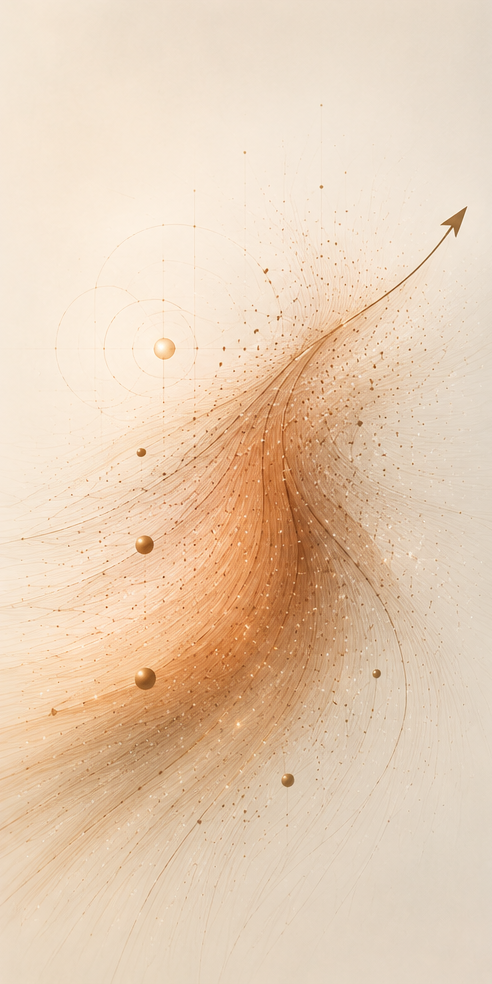
Where difference exists, direction emerges. Not as a decision, but as a structural consequence. V is the operator through which asymmetry becomes movement.
Direction emerges from differences in pressure, tension, attraction or timing. A river does not choose the sea — the gradient determines its course. V registers that movement, in whatever form it takes.
Direction can move in any way: forward, backward, oscillating, collapsing, expanding.
The V symbols describe the quality of movement — not only its speed or goal. A system that withdraws (<) is just as much in motion as a system that accelerates (>>>).
The difference lies in what generates the movement: energy or exhaustion, coherence or fragmentation, direction or chaos.
Without asymmetry
there is no movement.
Without movement
there is no time.