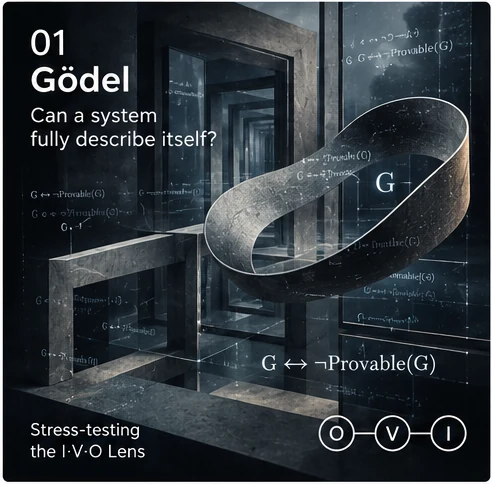
Question
Can a sufficiently expressive system completely describe itself using only the resources available within that system?
Why this is a hard case
Gödel's incompleteness theorems create a particularly severe test for any analytical framework concerned with observation, structure and self-reference.
The original stress test focused on the distinction between truth and provability. In a sufficiently expressive formal system, statements can arise that cannot be proven from within that same system, assuming the relevant consistency conditions. The system therefore encounters limits when it attempts to include its own descriptive closure within itself.
This is not merely a problem of missing information. The limitation emerges from the architecture of the formal system itself.
O — Structured Possibility
The possibility space is not arbitrary.
It is constrained by:
- axioms;
- formal rules;
- expressibility;
- self-reference;
- the distinction between system and meta-system.
Within that structured space, some statements can be formulated even when their truth cannot be established by the system's own proof machinery.
O therefore contains possibilities that are structurally available but not necessarily internally decidable.
V — Instantiated Relation
The central instantiated relation is:
statement ↔ proof system
More specifically:
truth claim ↔ provability within a given formal system
Gödel's result exposes an asymmetry within this relation. Truth and provability cannot simply be treated as interchangeable properties.
The important point for the Lens is not that “the system changes,” but that a particular relation between statement, proof and formal system becomes instantiated and reaches a structural limit.
I — Situated Selectivity
The decisive selection concerns which distinctions count within the analysis:
- true / false;
- provable / unprovable;
- system / meta-system.
The original stress test already identified the importance of changing observational level: what cannot be decided inside one formal frame may become describable from a meta-level.
I is therefore situated relative to the formal resources from which distinctions are made.
What the test exposed
The test exposed a limit to complete self-description.
A system may generate structures that cannot be fully resolved using only its own internal rules.
The boundary does not arise because the observer has insufficient patience or computational power. It can arise from the structure of the system itself.
What changed in the Lens
This stress test contributed to separating two analytical directions:
- reconstruction from an observed distinction;
- generation from a structured possibility space.
It also pushed the Lens away from assuming that one analytical level can necessarily contain its own full description. The earlier development notes explicitly identify Gödel as one of the tests that pushed the framework toward reflexivity and the distinction between system and meta-system.
What survived
The separation between possibility, instantiated relation and situated selection remained analytically useful.
More importantly, the test suggested that analytical separability does not require complete self-containment.
Open question
Can any sufficiently rich analytical system fully represent the conditions under which its own distinctions become possible?
Historical note
This test was conducted during an earlier development stage of the I·V·O Lens. The original terminology used Possibility Space, Relational Change and Observation / Distinction. The current presentation maps the structural finding onto the v4.0 operators without claiming that the original test was performed using the present terminology.