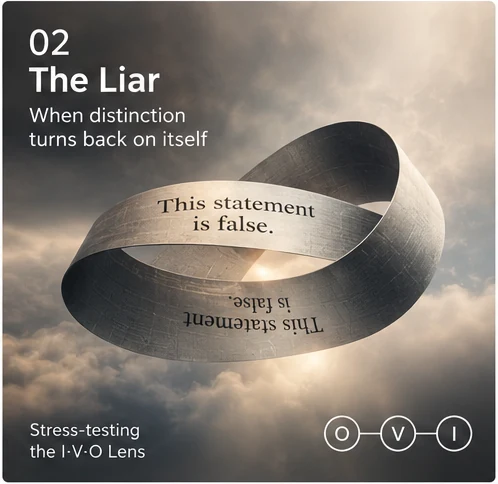
Question
What happens when a distinction is applied to a statement whose content recursively depends on that same distinction?
Why this is a hard case
Consider:
“This statement is false.”
If it is classified as true, its content implies that it is false.
If it is classified as false, its content appears to imply that it is true.
The original test described this as a closed feedback loop between statement and classification.
The difficulty is therefore not simply semantic confusion. The act of classification becomes structurally entangled with what is being classified.
O — Structured Possibility
The possibility space permits:
- statements;
- truth assignments;
- reference between statements;
- self-reference.
The original analysis identified an important hidden assumption: that every statement must fit stably into the binary categories true or false.
Once self-reference is admitted, that binary possibility structure becomes unstable.
O is therefore not just a set of available labels. It includes the rules that determine which kinds of self-reference are permitted.
V — Instantiated Relation
The decisive relation is:
statement ↔ truth classification
This relation becomes recursively instantiated.
The classification does not merely describe the statement from outside. The content of the statement refers back to the classification itself.
The original test captured this as a feedback loop in which each classification activates its opposite.
I — Situated Selectivity
The selective act is the attempt to force the statement into:
true / false
The observer's distinction is therefore not neutral to the analytical structure. It determines the category system within which the paradox appears.
The original analysis explicitly asked whether an entire class of statements might instead expose the boundary of the classification system itself.
What the test exposed
The paradox may be less a failure of truth than a failure of a particular distinction under self-reference.
The instability appears when a classification mechanism is allowed to act recursively upon its own conditions.
What changed in the Lens
The test strengthened the idea that distinctions themselves can become unstable.
It also contributed to later thinking about whether stability should be treated as a consequence to measure rather than silently assumed.
What survived
The separation between:
- what is structurally permitted;
- which relation is instantiated;
- which distinction is applied;
remained useful.
The paradox does not erase O, V and I. It reveals how tightly coupled they can become.
Open question
What is the smallest change to the possibility structure that stabilizes self-reference without simply prohibiting it?
Historical note
The original test used an earlier formulation in which I was strongly associated with observation and classification. The current version interprets the crucial issue more narrowly as situated selectivity within a self-referential structure.