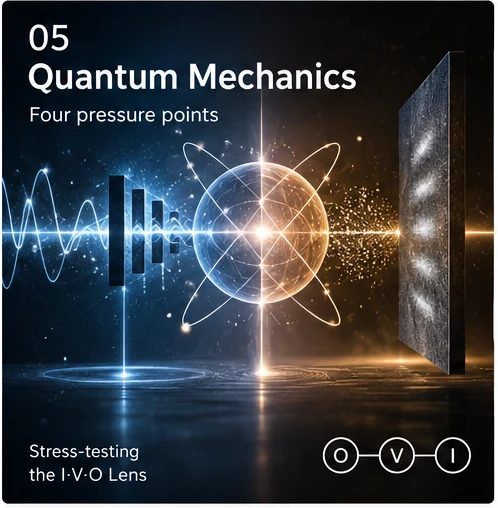
Question
Can O, V and I remain analytically distinct when quantum theory places possibility, relation and measurement under simultaneous pressure?
Why this is a hard case
Quantum mechanics is not one stress test but several.
The original document separated four:
- superposition;
- measurement;
- entanglement;
- decoherence.
Each pressures a different part of the Lens.
This is particularly useful because no single interpretation of quantum mechanics should be smuggled into the framework as established fact.
O — Structured Possibility
Superposition
Before measurement, the formalism represents multiple possible outcomes within a structured state space.
The stress point is whether possibility can have physical significance before a definite outcome is selected.
The earlier test associated superposition primarily with O.
Under v4.0, the cautious formulation is:
O represents the structured field of possible outcomes described by the formalism.
It does not by itself decide which interpretation of the quantum state is ontologically correct.
V — Instantiated Relation
Entanglement
Entanglement places relational structure under pressure.
The state of a composite system cannot always be represented as independent states of its components.
The original stress test therefore asked whether relations can be more fundamental to the description than isolated objects.
V is useful here as instantiated relation:
the relevant structure lies in correlations among components, not merely in separate object properties.
I — Situated Selectivity
Measurement
Measurement introduces a concrete selection context.
A measurement apparatus, observable and experimental arrangement determine which distinction can become instantiated as a result.
The original test asked whether observation changes only knowledge or also the described state.
The Lens should not answer that interpretive question in advance.
Instead, I marks the situated selective conditions under which a definite recorded outcome becomes available.
The O–V–I interface
Decoherence
Decoherence stresses the interfaces among the operators.
The original test linked it to the transition between quantum possibilities and stable classical experience.
Under the current Lens, the interesting issue is not simply “possibility becoming reality.”
It is how structured possibilities, system-environment relations and situated records jointly produce the stable distinctions accessible to observers.
What the test exposed
Quantum mechanics punishes careless category errors.
Possibility must not automatically be equated with physical coexistence.
Relation must not automatically be equated with signal or causal influence.
Selection must not automatically be equated with consciousness.
What changed in the Lens
This family of tests forced sharper separation between analytical function and ontological claim.
That is one of the most important lessons in the current framework.
What survived
The three-way decomposition remained useful because different quantum problems place pressure on different functions.
The original summary captured this neatly:
- superposition → O;
- entanglement → V;
- measurement → I;
- decoherence → the interface.
Open question
Can the same O–V–I decomposition remain informative across competing interpretations of quantum mechanics without silently privileging one of them?
Historical note
The original stress test used stronger language such as “observation forceert een onderscheid” and “possible outcomes → observed outcome.” The current version deliberately weakens those formulations where they risk implying a particular interpretation of quantum measurement.