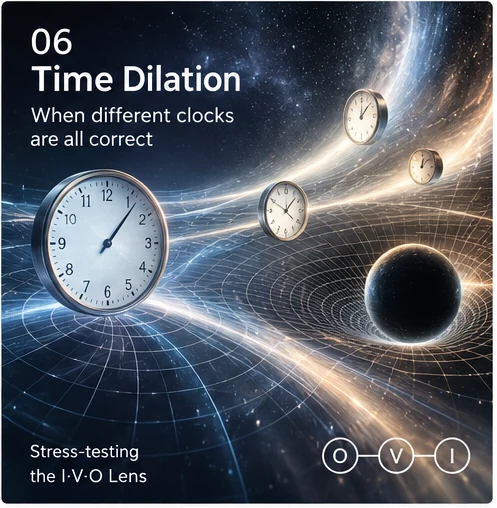
Question
How can two clocks disagree while both remain physically correct within their own trajectories?
Why this is a hard case
Ordinary intuition expects one underlying time against which clocks can be judged.
Relativity breaks that intuition.
The original stress test starts from a possibility space in which:
- observers have local clocks;
- time is associated with worldlines;
- relative velocity matters;
- gravitational conditions matter;
- clocks can later be compared.
The challenge is therefore not to decide which clock is wrong.
It is to understand the relational structure that makes different elapsed times possible.
O — Structured Possibility
O contains the space of physically possible worldlines, velocities and gravitational conditions.
Different trajectories through spacetime permit different accumulated proper times.
The possibility space is therefore structured by relativistic geometry rather than by a single universal clock.
V — Instantiated Relation
The key relation is:
clock ↔ worldline
and, when observers compare results:
worldline ↔ worldline
The original stress test correctly identified that the important structure appears in the relation between clocks rather than in a clock considered in isolation.
Under v4.0, V is the instantiated relation connecting a particular clock with a particular trajectory and comparison context.
I — Situated Selectivity
Each observer occupies a situated physical frame.
The relevant distinction depends on where and how comparison occurs.
Locally, each ideal clock correctly measures its own proper time.
A difference becomes visible when trajectories are related and compared.
I therefore does not select a universally “correct” clock.
It selects from a situated frame within a relational geometry.
What the test exposed
Different descriptions do not necessarily imply contradiction.
They may be correct relative to different physical positions or trajectories.
This is important well beyond relativity: perspective dependence must not automatically be confused with error.
What changed in the Lens
The test contributed to the local-clock principle:
analysis should not assume a universal temporal frame when the system itself contains multiple locally valid temporal structures.
This principle appears explicitly in the earlier development priorities.
What survived
O, V and I remained separable:
- O constrains which worldlines are physically possible;
- V instantiates particular clock–worldline and worldline–worldline relations;
- I specifies the situated position from which temporal distinctions become available.
Open question
How far can the local-clock principle be generalized beyond physics before it stops being a useful structural analogy?
Historical note
The original test described V as “the changing relation between clocks.” The v4.0 formulation is stricter: V is the instantiated relation among clocks, worldlines and comparison conditions; change can occur within that relation but is not what defines V.