I·V·O Lens Stress Test

Stress-test
the Lens.

Six deliberately different objects. One frozen protocol. The same three operators.

This is a stress test, not a showcase of six tailored methods. Every reading below was produced with exactly the same Canonical AI Prompt. Only the object changed.
← Read the public I·V·O Lens on .com
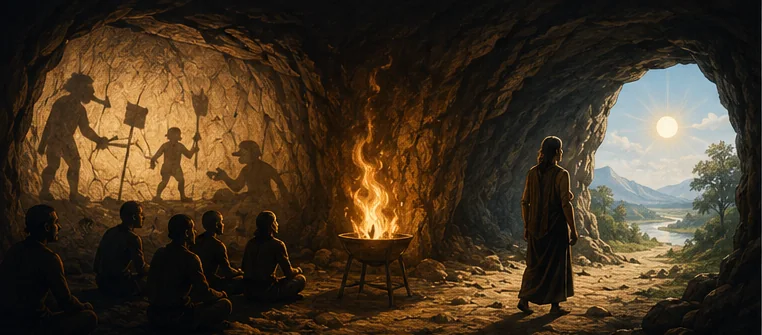
Prisoners, shadows and a freed observer in Plato's cave
01

Plato's Allegory of the Cave

Object: Philosophical text
Direction: both · OVI dominant

O — Possibility Space

The cave is a restricted space. The prisoners can perceive shadows, but not the source that makes those shadows possible.

V — Relational Change

The freed prisoner moves through changed relations: shadow to fire, fire to outside world, outside world to sun.

I — Distinction

The returning prisoner cannot transfer his new distinctions to observers who still lack that position.

Question behind the question: can an observer see their own possibility space from within?

What becomes visible: the cave is not only about ignorance. It is about the architecture of observation itself.
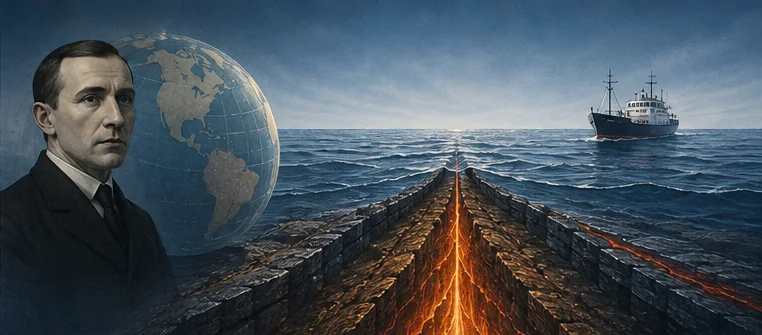
Alfred Wegener, the ocean floor and a research vessel revealing plate tectonics
02

The Discovery of Plate Tectonics

Object: Scientific paradigm shift
Direction: IVO · instrument-driven

O — Possibility Space

Wegener opens the possibility of continental drift in 1912, but the idea remains dormant without a mechanism.

V — Relational Change

Seafloor spreading and mantle convection later change the relations: not continents plowing, but plates moving.

I — Distinction

Sonar and paleomagnetism produce distinctions on the ocean floor before the field knows how to think them.

Hidden assumption: that a revolution begins with a thinker.

What becomes visible: a possibility space can exist without being active until instruments awaken it.

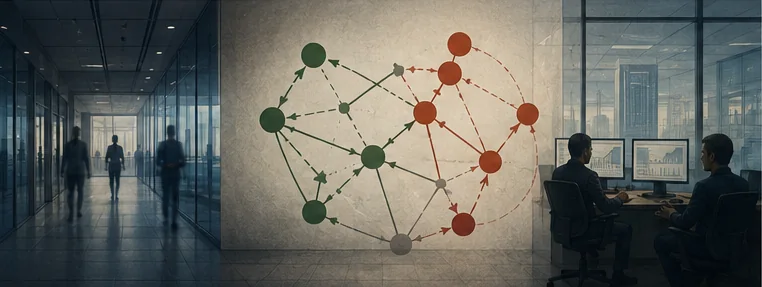
An organization in transition with changing relational networks
03

An Organization in Transition

Object: Healthcare reorganization
Direction: IVO

O — Possibility Space

New collaboration is announced, but old schedules, systems and locations keep the practical field closed.

V — Relational Change

Trust shifts: employees strengthen relations with each other while the relation with leadership weakens.

I — Distinction

Management observes dashboards; teams observe daily practice. Both are coherent, but not shared.

Question behind the question: which possibility space have we actually opened?

What becomes visible: resistance is not a property of people, but a relational movement produced by the field.

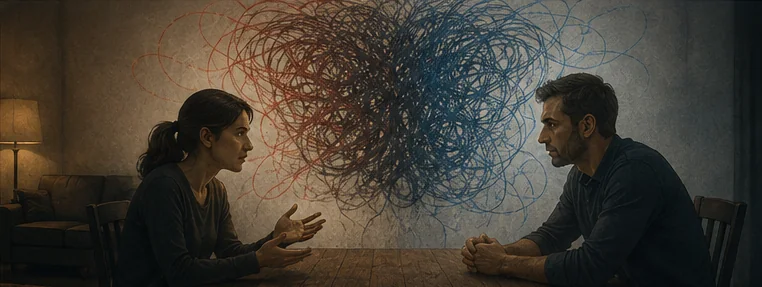
Two people in a recurring conflict with tangled relations between them
04

A Conversation That Keeps Getting Stuck

Object: Recurring partner conflict
Direction: both

O — Possibility Space

The conversation happens late, tired and triggered. That space excludes calm exploration before content begins.

V — Relational Change

The topic changes, the pattern does not: accusation, defense, withdrawal, distance.

I — Distinction

Both observe from woundedness. Neither sees that the fight is about who is being seen.

Hidden assumption: that the conflict is about the content.

What becomes visible: different conditions can change more than better arguments, because they create another possibility space.

Books transformed through an attention network into parallel language relations
05

An AI Paper

Object: Attention Is All You Need
Direction: OVI

O — Possibility Space

Before 2017, language models were bounded by sequential processing. Parallel relations were structurally excluded.

V — Relational Change

The transformer replaces sequence with relation: attention computes relations between all words simultaneously.

I — Distinction

The title itself draws the distinction: what is essential is relation; recurrence becomes optional.

Question behind the question: is language a sequence or a structure of relations?

What becomes visible: the lens analyzing this paper runs on the architecture the paper describes. I is reflexive here.

An artificial intelligence and a human observer separated by a complex field
06

AI Alignment

Object: Proxy optimization and human intent
Direction: OVI · structural asymmetry

O — Possibility Space

Training data, architecture, environment and reward function form the field within which proxy-optimized behaviour can arise.

V — Relational Change

The proxy direction and the intended human direction may initially coincide, then diverge as capability or context changes.

I — Distinction

The system sees the measurement, not the human observer position from which intention, responsibility and meaning are judged.

Question behind the question: can one observer position directly access the direction of another without a distorting field between them?

What becomes visible: alignment is not only a better-specification problem. It is a structural asymmetry that has to be managed architecturally, relationally and institutionally.

Read the research note on .com →

Read another
object.

Use the canonical prompt to apply the same protocol to a document, question or system of your own.

Open the Canonical AI Prompt on .com →